
my internal communication is by design…
I diagnose what employees need to understand, advise leaders on how to say it, build the channels and governance that carry it, and stay accountable for whether it worked. The results below include an editorial system that replaced ad hoc requests with a governed pipeline, a compliance guide whose framework survived into the published version, and a sustainability resource that originated from my own observation that employees deserved better than a page of links.
Case details are generalized to respect employer confidentiality; diagrams shown are my own illustrations, not company property.
Strategy & counsel
Several functions bring me their hardest communication problems: HR, Compliance, IT, EHS, Internal Controls, L&D and more. I advise on tone, timing and disclosure for high-priority and sensitive matters, and draft leadership remarks in their voice. When HR Benefits ran health awareness webinars framed around women’s health, I ensured on communicating them as resources for all employees, the kind of framing that makes every attendee feel the session is for them, which speakers reinforced on their own once the point was raised. The campaign framework was redeployed successfully the following year.
Change & adoption
Most of my work helps an enterprise accept something new: an ergonomics program, a purchasing process, employee resource groups, onboarding journeys. I map audiences (remote, office-based, production-floor employees hear things differently), sequence launches in phases rather than blasts, and translate technical capability into employee-facing value.
Editorial leadership
I own the company’s global employee newsletter end to end and serve as managing editor of an internal publication read across the enterprise. I’ve also assessed how employee stories get sourced and published, and designed a 12-month editorial operating model to replace ad hoc content requests with a governed pipeline and repeatable storytelling formats. The design is complete; implementation is the next chapter, and the structure is built to prove itself in measures once it runs.
Case Study: From Ad Hoc to Architecture
Rebuilding the global news channel as a sensing, measuring, compounding system.
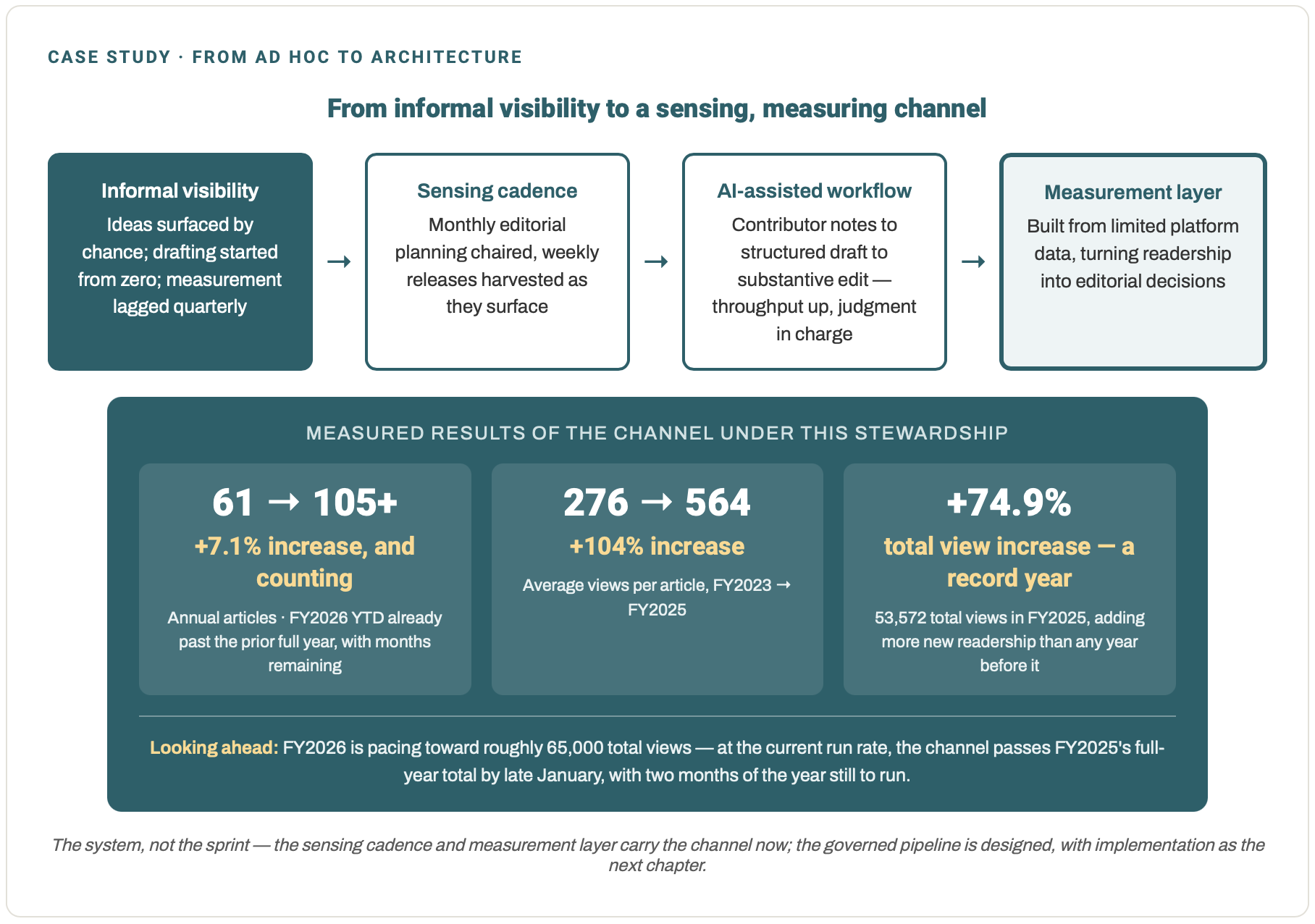
CONTEXT: The company’s global news channels serve 8,000+ employees. As managing editor of the internal newsletter, I was its primary producer, but the news methodology was not uniform. It sometimes ran on informal visibility: article ideas surfaced when someone happened to mention them, details were gathered by request, and drafting started from a blank page. Measurement included mainly quarterly reviews of email metrics, because the intranet platform offered little native analytics.
THE CHALLENGE: Convert a reactive, low-visibility channel into a sensing, measuring, compounding system — without a newsroom team — and prove the transformation in data the platform itself didn’t provide.
MY ROLE & APPROACH: I own the news channel end to end: editorial strategy, contributor management, publishing operations and performance analysis. When communications leadership added a monthly editorial planning meeting and a weekly release meeting to the team’s cadence, I converted both into production infrastructure: I chair the monthly editorial meeting — the standing forum for what corporate communications and businesses news can join the newsletter — and treat the weekly release meeting as my production trigger, harvesting everything publishable the moment it surfaces.
An AI-assisted drafting workflow (contributor notes to structured draft to my substantive edit) collapses turnaround time without surrendering editorial judgment. And where the platform’s metrics ended, I built the measurement layer myself, assembling and evaluating intranet performance data from what’s available.
IMPACT: Annual output grew from 61 to 89 to 98 articles, and the current year (2026) surpassed the prior full year’s count with months remaining, on pace to roughly 169. Total views grew 101.6% one year and 74.9% the next; cumulative readership stands at 139,822 views across 353 articles. Average views per article rose 104%, from 276 to a peak of 564. A single record quarter delivered 48 articles and 19,058 views.
The email program carrying the channel sustained ~68.8% average open rates with 440,988 opens year to date, deep reading up two points to 87.08%. At the current run rate, FY2026 is pacing toward roughly 65,000 total views — passing FY2025’s full-year record by late January, with two months of the year still to run.
WHAT ENDURED: The system, not the sprint. The sensing cadence (monthly planning, weekly release) is now how the channel sees ahead; the drafting workflow is how it sustains record throughput with one managing editor; and built the measurement practice on limited raw data. The governed pipeline, designed with implementation as the next chapter, is built to carry the trajectory forward while my attention shifts to higher-order editorial judgment.
Case Study: Editorial Transformation of Code of Conduct Guide
A policy artifact rebuilt as a reader-centered experience — led in my first year, surviving two years into the published guide.
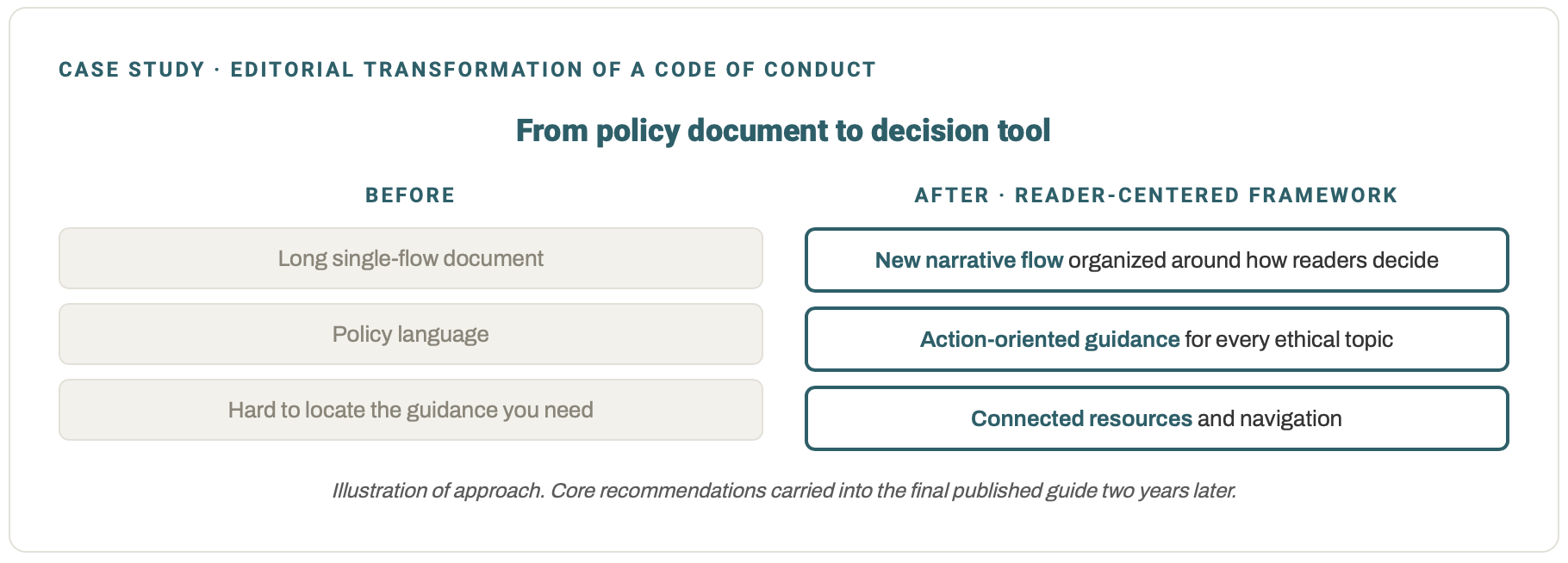
CONTEXT: A lengthy, text-heavy code of conduct guide sat at the center of the company’s ethics program. It was a high-visibility compliance document functioning as a reference that needed to be easily understood.
THE CHALLENGE: Transform a policy artifact into a reader-centered experience, without diluting legal precision, and do it as the editorial lead, in my first year, on a document the whole enterprise would scrutinize.
MY ROLE & APPROACH: I was selected by Corporate Communications leadership to manage the editorial transformation. I benchmarked peer-company codes of conduct, diagnosed usability and content-architecture gaps, and rebuilt the document’s narrative architecture around a reader-centered framework: reorganized flow, a new headline and subheading system, action-oriented guidance for every ethical topic, and centralized linked resources.
IMPACT: The transformation established the editorial foundation for the final Standards of Business Conduct: reorganized flow, navigation that employees could actually use, and guidance expressed as action rather than abstraction.
WHAT ENDURED: When Compliance finalized the guide two years later, several core recommendations remained — including the action-based framework, adapted as “commit to / refrain from” guidance aligned with the company’s purpose. Advice that survives two years and a change in hands is the outcome I aim for. Became trusted counsel for future project on how the accompanying policy site should operate, balancing enterprise-wide access with subsidiary-specific visibility.

